
 |
 |
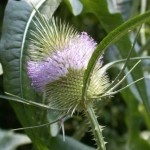 |
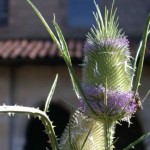
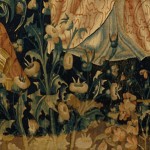
Above, from left: The medicinal teasel, Dipsacus fullonum, growing in Bonnefont garden; a teasel depicted in the foreground of The Hunt of the Frail Stag: Vanity Sounds the Horn, and Ignorance Unleashes the Hounds Overconfidence, Rashness, and Desire, South Netherlandish, about 1500???1525, Wool and silk, The Metropolitan Museum of Art, New York, Bequest of Mary Stillman Harkness, 1950 (50.145.4); detail of the flower head, whose straight spines distinguish this species from D. sativus.
The principal medieval uses of the wild teasel, Dipsacus fullonum, were medicinal. (See last week’s post for uses of the cultivated form.) In the De Materia Medica (Book III. 13), the ancient herbalist Dioscorides groups teasel with other prickly plants of the thistle tribe, but teasel does not belong to the Compositae (daisy) family, as true thistles do. (I wrote extensively about thistles last year. See a list of thistle-related posts.) Dioscorides compares the spiny flower head of the teasel to a hedgehog, and gives several medicinal uses for small “worms” that can be found inside: sufferers from intermittent fevers were instructed to put the worms in a purse and hang it around their necks. He also recommended mixing the root with wine to cured anal fissures and fistulas.
The teasel, or ‘Cameleon,’ is depicted in a number of medieval herbal manuscripts, including the Herbal of Apuleius Platonicus. Although the representations of teasel in these sources vary widely in their realism, the spiny heads are consistently emphasized. In general, the prickly character of the plant seems to have been taken as a sign of its efficacy against fistulas and hemorrhoids, boils, abscesses and ulcers of all kinds, and poisoned bites.

The fifteenth-century Herbarius Latinus maintains that the plant was also a strong diuretic. [According to the Roman natural historian Pliny, the plant grew on watery ground (Book XXVII.71)]. The name Dipsacus given to the genus derives from the Greek verb “to be thirsty,” and the propensity of the plant to gather rainwater and dew in the cup??formed by its perfoliate (pierced by the stem) leaves has been noted since antiquity. It was known to the Romans as labrum Veneris, or “Venus???s lip.” One of the common names used by Renaissance writers is ???Venus???s basin.??? The water gathered in the plant’s leaves was believed to have cosmetic and curative powers and to be especially effective in removing warts. In Adam in Eden, a history of plants??published in 1568, the herbalist William Coles uses the teasel???s association with Venus and its prickliness to point a moral lesson, comparing the flower heads to whores who tear and destroy both the estates and the bodies of those who consort with them.
The teasel represented in the foreground of the tapestry shown above may have been used to enhance the work’s allegorical theme. The Hunt of the Frail Stag is a symbolic representation of human frailty and vulnerability to vice. The teasel in the scene may symbolize the toil and tribulation??brought into the world at??the Fall of Man. (According to the book of Genesis, thistles and thorns did not exist in Eden, but came into being when God cursed the earth after Adam and Eve sinned.) Another fragment from the same series, currently on view at The Cloisters, shows Old Age driving the stag out of a lake. The hounds Heat, Grief, Cold, Anxiety, Age, and Heaviness pursue him and a large and very thorny rosebush is shown beneath the forelegs of the stag.
???Deirdre Larkin
Sources:
Anderson, Frank J, ed. “Herbals through 1500,” The Illustrated Bartsch, vol. 90. New York: Abaris, 1984.
Grieve, Maude. A Modern Herbal. 1931. Reprint: New York: Dover Publications, 1971.
Grigson, Geoffrey. The Englishman???s Flora. 1955. Reprint: London: J. M. Dent & Sons, 1987.
Gunther, Robert T., ed. The Greek Herbal of Dioscorides Translated by John Goodyer 1655. 1934. Reprint. New York: Hafner Publishing, 1968.
Tags: Dipsacus_fullonum, teasel
October 28, 2009 at 2:45 pm
thanks, Deirdre! your blog so inspires my writing! now i also know where those pesky thorns come from! also, i’m thinking burrs - yup, now i know where they came from too!! t
October 29, 2009 at 4:46 pm
Hi, Thea—I haven’t gotten around to discussing burrs yet, but we have grown burdock (Arctium lappa) in the medicinal bed in Bonnefont Garden in years past. Although a cultivated form of burdock known as ‘gobo’ is a traditional vegetable in Japan, and has now become popular in the United States, most Americans know burdock as a noxious weed. The Swiss inventor of Velcro was directly inspired by the burrs that clung to his pants after a walk.
April 6, 2010 at 9:26 pm
A related species, Dipsacus japonicus is still widely used in traditional Chinese medicine, primarily for musculoskeletal conditions such as the results of trauma or back and joint pain. A few contemporary American herbalists have adopted these uses for the D. sylvestris, and on these indications it has recently gained a reputation for being useful in cases of chronic Lyme disease. Other than that, there seems to be very contemporary info about this herb.
JH
April 7, 2010 at 9:31 am
Dear JH,
While we focus on the history of medicinal herbs here, and investigate their medieval applications, rather than their use in contemporary practice, clinical research may confirm a historical use—this is not surprising, as a given culture’s knowlege of a plant’s medicinal action is usually based on many centuries of practical experiment. Some plant families are particularly rich in bioactive substances, and related species may be used in similar ways in different medical traditions. A comparative ethnobotany, in which Greco-Roman, Chinese, and Ayurvedic medicinals could be studied side by side would be fascinating and illuminating, but would require a very ambitious collaborative effort between botanists, historians, and practitioners.
July 26, 2010 at 5:59 am
You learn something everyday. Teasels can be very useful
July 28, 2010 at 5:27 am
I have been doing some research into natural and herbal remedies for hemorrhoids and this is the first reference i have found for the teasel. I wonder if there have been any recent studies as to the effectiveness as a treatment.
Always interesting to see early treatments, surprisingly so many prove to effective alternatives to our modern drugs
July 28, 2010 at 4:01 pm
I’ve always found the herbal way of healing to be a more natural and healthy approach.
November 16, 2011 at 10:30 pm
What I like about wild teasel is that it can grow anywhere like in a weed of old fields, pastures, hayfields, turfgrass, ditches, canals, roadsides, disturbed areas and as what I know it can also be use as alternative medicine in some disease.