Archive for the ‘Magical Plants’ Category
Wednesday, December 18, 2013
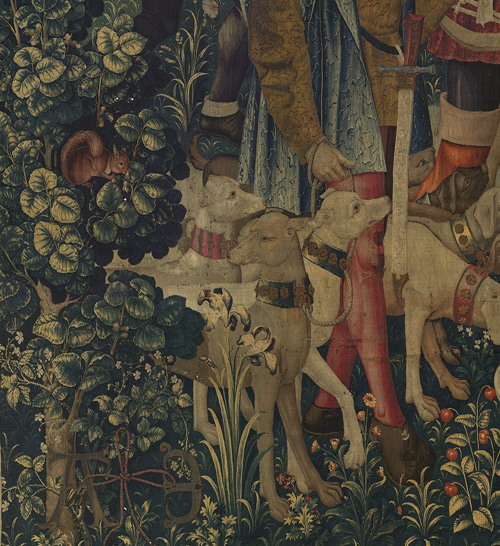
Detail of hazel tree in The Unicorn is Killed and Brought to the Castle (from the Unicorn Tapestries), 1495–1505. The Metropolitan Museum of Art, New York, Gift of John D. Rockefeller Jr., 1937 (37.80.5)
The common hazel, or Corylus avellana, is an understory tree native to Europe and western Asia and is widely distributed from Scandinavia to the Mediterranean. The English name for the tree is derived from the Anglos-Saxon word haesel. The hazel appears in two critical medieval horticultural sources, the Carolingian Capitulare de Villis and in the St. Gall Plan, along with references in folklore, literature, and both Pagan and Christian traditions. The hazel is still cultivated today for its nuts, which are harvested after they have fallen from the tree in autumn. Hazelnuts are commercially grown in Oregon and Washington, although Turkey exports 75% of the world’s supply. Read more »
Tags: hazel, Unicorn tapestries
Posted in Food and Beverage Plants, Magical Plants, Medicinal Plants, Plants in Medieval Art | Comments (1)
Friday, September 21, 2012
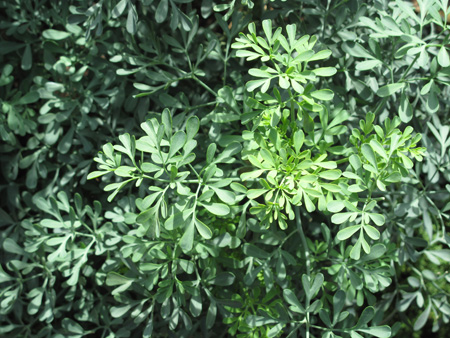
The blue-green fronds of rue were admired for their beauty in the Middle Ages, and the intensely aromatic leaves were prized as a condiment, a medicament, and an amulet.?? Photograph by Carly Still
Here is a shadowed grove which takes its color
From the miniature forest of glaucous rue.
Through its small leaves and short umbels which rise
Like clusters of spears it sends the wind???s breath
And the sun’s rays down to its roots below.
Touch it but gently and it yields a heavy
Fragrance. Many a healing power it has ???
Especially, they say, to combat
Hidden toxin and to expel from the bowels
The invading forces of noxious poison.
???Hortulus, Walahfrid Strabo, translated by Raef Payne
Read more »
Tags: Anethum graveolens, Apicius, Apium graveolens, bitter, Capitulare de Villis, Dioscorides, Hildegard of Bingen, Hortulus, Mithridates VI, mithridatum, phytodermatitis, Pliny, rue, Ruta graveolens, St. Gall, Tacuinum Sanitatis, Walahfrid Strabo
Posted in Food and Beverage Plants, Fragrant Plants, Gardening at The Cloisters, Magical Plants, Medicinal Plants | Comments (0)
Friday, August 24, 2012
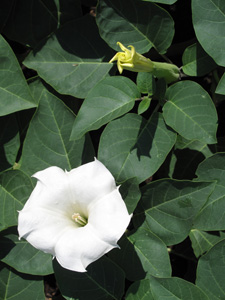
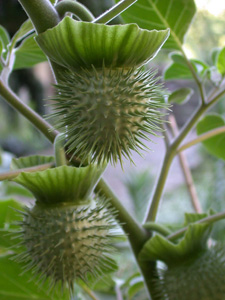
Downy thorn apple (Datura metel) growing in a bed in Bonnefont garden devoted to plants used in medieval magic. The common name “thorn apple,” shared with other members of the genus, is derived from the character of the spiny seed capsule. Above: D. metel in bud (left) and bloom (right). This handsome, heat-loving plant flowers profusely from late July until October. Below: Semi-ripe capsule of the downy thorn apple, broken open to show the developing seeds.
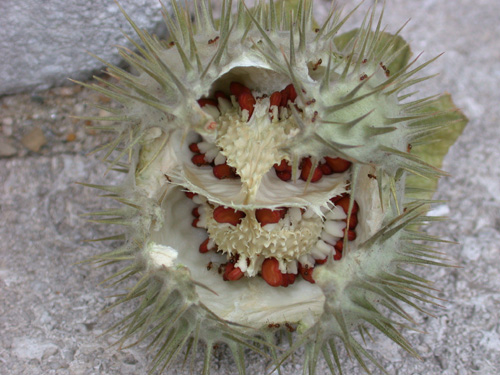
The beautiful but sinister thorn apple (Datura metel) is a powerfully hallucinogenic plant employed in medieval magic as well as medicine.
Read more »
Tags: alkaloid, Datura, Datura metel, Datura stramonium, Jimson weed, Solanaceae, thorn apple, thornapple
Posted in Gardening at The Cloisters, Magical Plants, Medicinal Plants | Comments (3)
Thursday, April 19, 2012
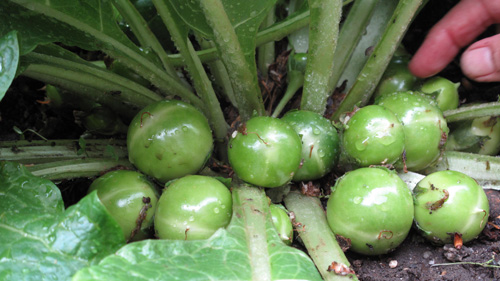
The mandrake above, which flowered in March, now bears a bumper crop of no less than twenty fruits, the largest number we’ve ever seen on a single plant here in Bonnefont garden. The fruits do not always ripen fully for us.?? Photograph by Carly Still
The mandrakes give a smell, and at our gates are all manner of pleasant fruits, new and old, which I have laid up for thee, O my beloved.
???Song of Solomon, 7:13
Read more »
Tags: Mandragora, Mandragora officinarum, mandrake, nightshade, Tacuinum Sanitatis, tomato
Posted in Fragrant Plants, Gardening at The Cloisters, Magical Plants | Comments (2)
Friday, March 23, 2012
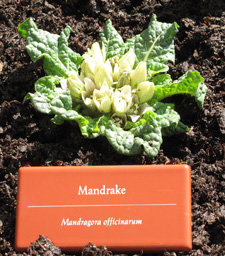
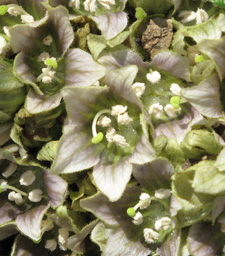
The mandrake, credited with both medicinal and magical powers over the course of many centuries, has accumulated more lore than any other plant in the Western tradition. Above: One of a colony of five spring-blooming mandrakes in Bonnefont garden. In March, this famous member of the nightshade family produces tight clusters of short-stemmed bell-shaped flowers.
Mandrake (mandragora) is hot and a little bit watery. It grew from the same earth which formed Adam, and resembles the human a bit. Because of its similarity to the human, the influence of the devil appears in it and stays with it, more than with other plants. Thus a person’s good or bad desires are accomplished by means of it, just as happened formerly with idols he made. When mandrake is dug from the earth, it should be placed in a spring immediately, for a day and a night, so that every evil and contrary humor is expelled from it, and it has no more power for magic or phantasms.
???Hildegard of Bingen, Physica (translated by Patricia Throop)
Read more »
Tags: alkaloid, Bartholomaeus Anglicus, Dioscorides, Hildegard of Bingen, John Gerard, Mandragora, Mandragora autumnalis, Mandragora officinarum, mandrake, nightshade, Pliny
Posted in Gardening at The Cloisters, Magical Plants, Medicinal Plants | Comments (10)
Friday, October 28, 2011
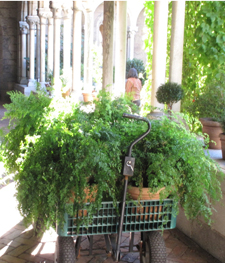
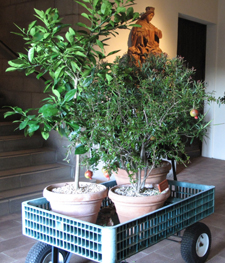
Potted plants too tender to spend the winter in Bonnefont garden are trucked inside and brought up to Cuxa cloister, which is??glazed in mid-October. Mediterranean plants such as bitter orange, myrtle, and bay laurel spend the cold season in the sunny arcades and??are brought back out to the herb garden when the glass comes down in mid-April. Left:??A wagonload of maidenhair fern in the arcade of Bonnefont garden. Right:??oranges and pomegranates en route to Cuxa cloister.?? Photographs by Carly Still
While the medieval plant collection at The Cloisters includes a good number of northern European species, a great many of the plants grown in the Bonnefont Cloister herb garden are Mediterranean in origin. Not all of these southern European plants are hardy for us here in New York City. The garden is a sheltered U.S.D.A. Hardiness Zone 7, and the fig tree (Ficus carica), poet’s jasmine (Jasminum officinale), and lavender (Lavandula angustifolia) do just fine outdoors, but more tender species like bitter orange (Citrus aurantium), rosemary (Rosmarinus officinalis), bay laurel (Laurus nobilis), and dittany of Crete (Origanum dictamnus) must be brought inside and protected from the cold. Read more »
Tags: Albertus Magnus, bay, Citrus aurantium, cucumber, cucurbit, dittany, fern, ficus carica, fig, jasmine, Jasminum officinale, laurel, Laurus nobilis, Lavandula angustifolia, Lavender, maidenhair, myrtle, orange, Origanum dictamnus, rosemary, Rosmarinus officinalis, santolina, winter
Posted in Food and Beverage Plants, Fragrant Plants, Gardening at The Cloisters, Introduction, Magical Plants, Medicinal Plants, Medieval Agriculture, Plants in Medieval Art | Comments (2)
Friday, July 1, 2011
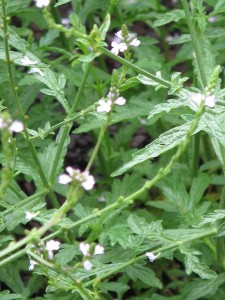
The medieval vervain was identified with the “holy herb” known to the Greeks and Romans. Despite its unprepossessing appearance, common vervain is one of the great magico-medical plants of the Western tradition.
Many odde olde wives tales are written of Vervaine tending to witchcraft and sorcerie, which you may read elsewhere, for I am not willing to trouble your eares with supporting such trifles as honest eares abhorre to heare.
???John Gerard, The Herbal or Generall Historie of Plants, 1597
Read more »
Tags: Pliny, Verbena officinalis, vervain
Posted in Magical Plants, Medicinal Plants | Comments (0)
Friday, June 24, 2011
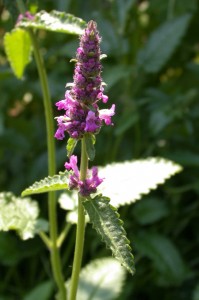
Wood betony (Stachys officinalis) enjoyed a considerable reputation in antiquity and the Middle Ages as both a medicinal and a magical herb, and was believed to have many virtues. Photograph by Nathan Heavers.
In the mountains and woods, in the meadows and depths of the valleys???
Almost everywhere, far and wide, grows the precious abundance
Of betony. Yet I have it too in my garden, and there
It learns a softer way of life in the tended soil.
So great is the honor this genus has won for its name
That if my Muse wished to add to it she would find herself
Defeated at last, overwhelmed; and soon she would see
She could add nothing more to the value it has already.
Perhaps you pick it to use it green, perhaps
To dry and store away for the sluggish winter.
Do you like to drink it from cloudy goblets? Or do you
Prefer to enjoy what it gives after long and careful
Refining? Whatever your fancy, the wonderful powers
Which this herb has will supply all your needs.
???From Hortulus by Walahfrid Strabo. Translated from the Latin by Raef Payne. The Hunt Botanical Library, 1966.
Read more »
Tags: Hortulus, Lamiaceae, mint, Stachys officinalis, Walahfrid Strabo, Wood betony
Posted in Magical Plants, Medicinal Plants | Comments (0)
Tuesday, July 13, 2010
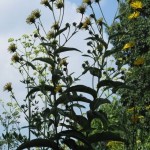
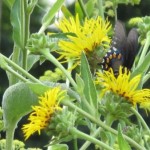
Above, left: Elecampane growing in a bed in Bonnefont garden devoted to??medieval vegetables. The bright yellow flowers of this striking plant are borne high on tall stems that can reach an imposing height of six feet. Right: Detail of the fringed flowers, typical of the daisy family. Photographs by Corey Eilhardt.
The tall and showy elecampane (Inula helenium) is a striking presence along roadsides, in pastures, and on waste grounds both in Europe and in the United States, where it is considered an invasive weed by the U.S.D.A., especially in the moist and shady situations it prefers. It is nevertheless still widely planted in ornamental gardens for its imposing height, bold foliage, and bright yellow flowers, which come into bloom at midsummer. Read more »
Tags: aromatic, daisy, elecampane, inula helenium, inulin, invasive, John Gerard, ornamental
Posted in Food and Beverage Plants, Fragrant Plants, Magical Plants, Medicinal Plants | Comments (1)
Wednesday, June 23, 2010
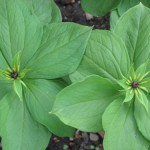
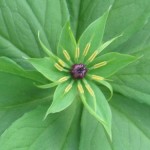
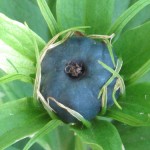
Above, from left to right: Herb paris (Paris quadrifolia) flourishing in the dappled shade of a quince tree in April (although typically four-leaved, five- and six-leaved forms of herb paris like these are not uncommon); a detail of the narrow-petaled, star-like green flower with golden stamens; detail of the single black fruit, ripening in late June. Photographs by Corey Eilhardt.
Herbe Paris riseth up with one small tender stalke two hands high; at the very top come forth foure leaves directly set one against another in the manner of a Burgundian Crosse or True-love knot: for which cause among the Antients it has been called Herbe True-love.
???John Gerard, the Grete Herbal, or Generall Historie of Plants
Trew-loue among men is that most is of lette,
In hates, in hodes, in porses, is sette.
Trewe-loue in herbers spryngeth in May.
Bot trew-loue of herte went is away.
???Popular Middle English rhyme.
The leaves of herb paris suggested both the the cross of Christ and the true-love knot to the medieval mind, and both these resemblances were exploited allegorically. The popular Middle English rhyme quoted above alludes to the custom of placing the spring-blooming herb paris in hats, hoods, or purses as a charm for luck in love, while stressing how quickly such love is lost. Read more »
Tags: arsenic, Fasciculus Morum, Geoffrey Grigson, Grieve, herb paris, Hortus Sanitatis, John Gerard, Juliet, medicine, mercury, pars, Pietro Mattioli, poison, quadrifolia, quatrefoil of love, Romeo, Susanna Greer Fein, true love, Venus
Posted in Magical Plants, Medicinal Plants | Comments (0)